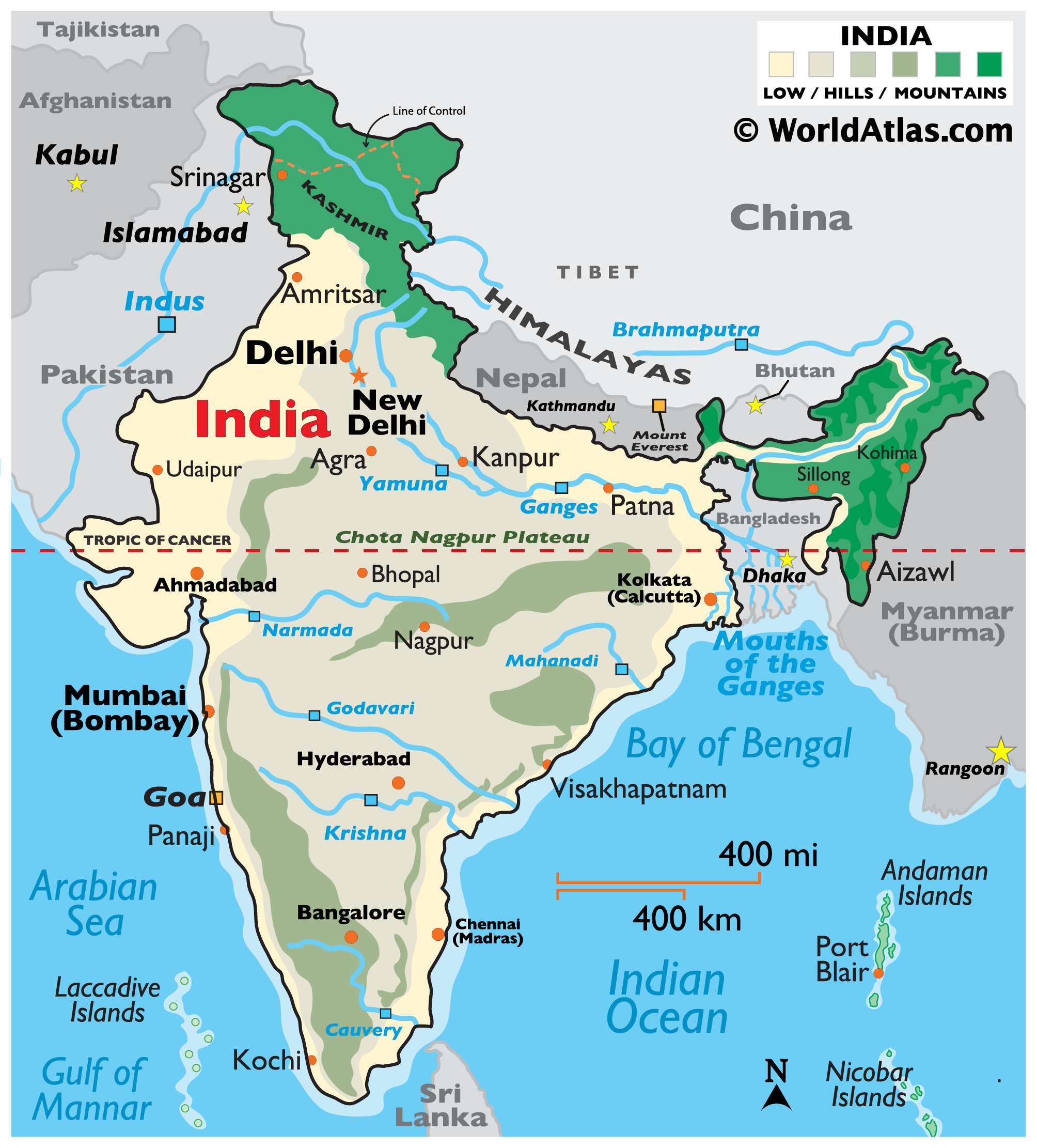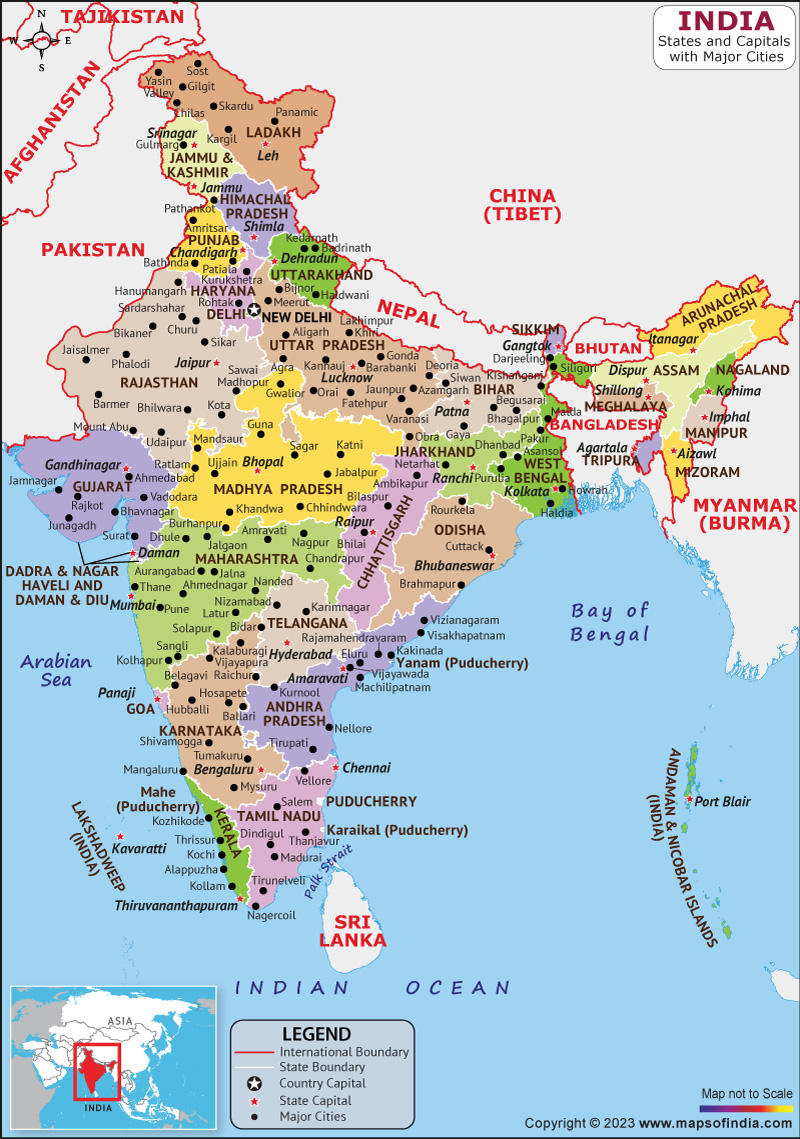
The outline of India, a shape instantly recognizable across the globe, is more than just a geographical representation. It’s a tapestry woven with threads of history, culture, political struggles, and geographical diversity. From the towering Himalayas in the north to the sun-kissed beaches of the south, from the arid Thar Desert in the west to the lush rainforests of the east, the shape encapsulates a land brimming with contrasts and complexities. This article delves into the significance of India’s outline map, exploring its historical evolution, geographical representation, political implications, and its enduring role in shaping the nation’s identity.
A Historical Journey: Mapping the Subcontinent Through Time
The modern outline of India is a product of centuries of exploration, conquest, and cartographic advancements. Long before modern surveying techniques, ancient Indian texts like the Vedas and Puranas contained cosmological and geographical descriptions, albeit often interwoven with mythology. Early maps were more conceptual and less precise, focusing on cardinal directions and the locations of important settlements and rivers.
The arrival of foreign powers, particularly the Mughals and the British, significantly influenced the development of accurate cartography. The Mughals, known for their meticulous administrative practices, commissioned detailed land surveys and maps for revenue collection and governance. However, it was the British who truly revolutionized mapping in India.
The Great Trigonometrical Survey (GTS), initiated in the early 19th century, was a monumental undertaking that aimed to precisely measure the entire Indian subcontinent. This project, led by individuals like William Lambton and George Everest (after whom Mount Everest is named), involved painstakingly surveying vast stretches of land, employing complex mathematical calculations, and establishing a network of triangulation points. The GTS laid the foundation for modern maps of India, providing accurate coordinates and elevations.
The partition of India in 1947, a tragic event that resulted in the creation of Pakistan, fundamentally altered the outline of the subcontinent. The Radcliffe Line, drawn by a boundary commission led by Sir Cyril Radcliffe, demarcated the new border, carving out East and West Pakistan (later Bangladesh). This event left an indelible scar on the Indian psyche and irrevocably shaped the nation’s geopolitical landscape.
The subsequent integration of princely states into the Indian Union further refined the map. Sardar Vallabhbhai Patel, India’s first Deputy Prime Minister, played a pivotal role in persuading the rulers of these autonomous regions to accede to India, consolidating the country’s territorial integrity. The annexation of Goa from Portuguese rule in 1961 and the incorporation of Sikkim in 1975 further contributed to the final form of India’s outline.
A Geographical Kaleidoscope: The Outline as a Container of Diversity
The outline map of India beautifully encapsulates the country’s remarkable geographical diversity. The northern border is dominated by the majestic Himalayas, a towering mountain range that acts as a natural barrier and influences the climate and hydrology of the entire subcontinent. The iconic peaks of the Himalayas, including Kanchenjunga and Nanda Devi, are reflected in the shape of the northern border, hinting at the immense geological forces that shaped the region.
South of the Himalayas lies the fertile Indo-Gangetic Plain, a vast alluvial expanse traversed by the mighty Indus, Ganges, and Brahmaputra rivers. This region, shaped by centuries of riverine activity, is the heartland of Indian agriculture and population. The outline of the plain reflects the meandering course of these rivers and the rich agricultural potential of the land.
To the west, the Thar Desert, also known as the Great Indian Desert, presents a stark contrast to the fertile plains. The arid landscape, characterized by sand dunes and sparse vegetation, is a testament to the harsh climatic conditions that prevail in the region. The outline of the desert reflects its vastness and the challenges it poses to human habitation.
The peninsular region of India, extending southward from the Indo-Gangetic Plain, is characterized by a diverse landscape comprising plateaus, coastal plains, and mountain ranges. The Western Ghats, a chain of mountains running along the western coast, are a biodiversity hotspot, while the Eastern Ghats, a discontinuous range of hills, contribute to the region’s unique ecological characteristics. The coastline, dotted with numerous ports and harbors, reflects India’s long history of maritime trade and cultural exchange.
The outline of India also encompasses a number of islands, including the Andaman and Nicobar Islands in the Bay of Bengal and the Lakshadweep Islands in the Arabian Sea. These islands, characterized by their unique ecosystems and cultural diversity, add another layer of complexity to the geographical tapestry of India.
Political Implications: Borders, Disputes, and National Identity
The outline map of India is not just a geographical representation; it is also a potent symbol of national sovereignty and territorial integrity. The borders of India, particularly those with Pakistan and China, have been the subject of disputes and conflicts for decades. The Line of Control (LoC) with Pakistan in Jammu and Kashmir and the Line of Actual Control (LAC) with China are constantly monitored and defended, highlighting the sensitive nature of these boundaries.
The depiction of the disputed territories in maps of India is a politically charged issue. The inclusion or exclusion of certain areas, such as Aksai Chin and Arunachal Pradesh, can have significant diplomatic implications. The Indian government maintains that these territories are an integral part of India, and their depiction in maps reflects this position.
The outline map of India also serves as a powerful tool for fostering national identity and promoting a sense of unity among the diverse population. It is prominently displayed in schools, government offices, and public spaces, serving as a constant reminder of the country’s territorial boundaries and its shared heritage.
The Enduring Allure: A Symbol of Nationhood and Potential
The outline map of India is more than just a line on a page; it’s a symbol of a nation steeped in history, brimming with diversity, and striving for progress. It represents the aspirations of over a billion people, their dreams, and their shared destiny. From school children learning about their country’s geography to policymakers charting the course of its future, the outline of India continues to inspire and resonate with generations.
As India continues to evolve and navigate the challenges of the 21st century, its outline map will remain a constant reminder of its rich heritage, its geographical diversity, and its unwavering commitment to national unity and territorial integrity. It’s a symbol that will continue to shape the nation’s identity and guide its journey towards a brighter future. The enduring allure of India’s outline lies not just in its geographical accuracy, but in its ability to evoke a sense of belonging, pride, and hope for a nation with a rich past and an even richer potential. It’s a testament to the power of a simple shape to represent a complex and vibrant nation.